Many are familiar with the ACH Network, which last year electronically moved 24.7 billion payments valued at nearly $56 trillion between accounts at different financial institutions for payments including large B2B transactions or payroll direct deposit.
Others may recognize the ACH Network as the payment system that funneled stimulus payments into millions of bank accounts upon the onslaught of COVID-19. But what some may not realize is that ACH is also growing quickly in a number of other industries as a secure and reliable payment method.
To learn more about three of these growth areas—donation payments, healthcare payments, and subscription payments—PaymentsJournal sat down with Brad Smith, Senior Director for Industry Engagement and Advocacy at Nacha, and Sarah Grotta, Director of Debit and Alternative Products Advisory Service at Mercator Advisory Group.
Using ACH for sustaining donation payments
Using ACH to make donations benefits both the donor and the charity or nonprofit receiving the funds.
Those that make donations through ACH make an average of 8.2 donations over a 12-month period. In contrast, those that rely on other forms of payment, such as checks or credit cards, make an average of just 3.5 donations in the same 12-month span. ACH donors also tend to donate more money, with an average of $1,700 in charitable donations over 12 months versus $650 for non-ACH donors.
Much of this is because ACH donors are significantly more likely to authorize recurring payments out of their checking account. While a mere 9% of donors using alternate payment types authorize recurring payments, 71% of ACH donors do.
“The goal of nonprofits is to secure sustaining donations, which are those given month after month,” Smith said. “It’s a significant benefit to a nonprofit when its donation becomes part of a consumer’s monthly bills.”
Further, debit and credit cards expire, while checking accounts typically stay the same for years or even decades. The small percentage of cardholders that do authorize recurring donations need to be contacted by nonprofits to update their credit card information, adding friction to the donation process.
A bonus for ACH donors is that because of the inherently lower costs associated with ACH payments, more of their donation goes toward the cause they care about.
Using ACH for healthcare payments
Another area that is experiencing growth in the use of ACH payments is healthcare. In 2010, Nacha began working with the Council for Affordable Quality Healthcare (CAQH), which Smith described as the rules owner for healthcare claims processes. “It needed assistance for the payment portion of those claims,” Smith explained.
Then in 2013, the Department of Health and Human Services declared that healthcare electronic funds transfers (EFTs) must be made using an ACH corporate credit or debit (CCD). “Using the ACH network to make these payments has helped the healthcare industry a great deal, and there has been substantial growth in those payments since 2013,” Smith added.
In 2019, 343 million ACH payments were made between insurance companies and doctors, totaling more than $1.7 billion. While this is undoubtedly significant, it represents 70% of all healthcare claim payments, leaving room for growth. This is particularly true in the dental industry, where just 13% of claim payments are made by ACH.
Nacha is working on increasing the usage of ACH payments in the healthcare and dental industries to make those payments faster and more efficient through more industry engagement and awareness. For example, ACH is also a great payment choice for post-encounter billing, just as with other industries that do consumer billing; and for disbursing refunds in an over-payment situation.
Using ACH for subscription payments
Another great use case for ACH payments are recurring subscription payments. Grotta explained that subscription payments can be divided into two segments: box-of-the-month clubs and media purchases. The following chart breaks down the percentage of U.S. adults that have or had different types of subscriptions:
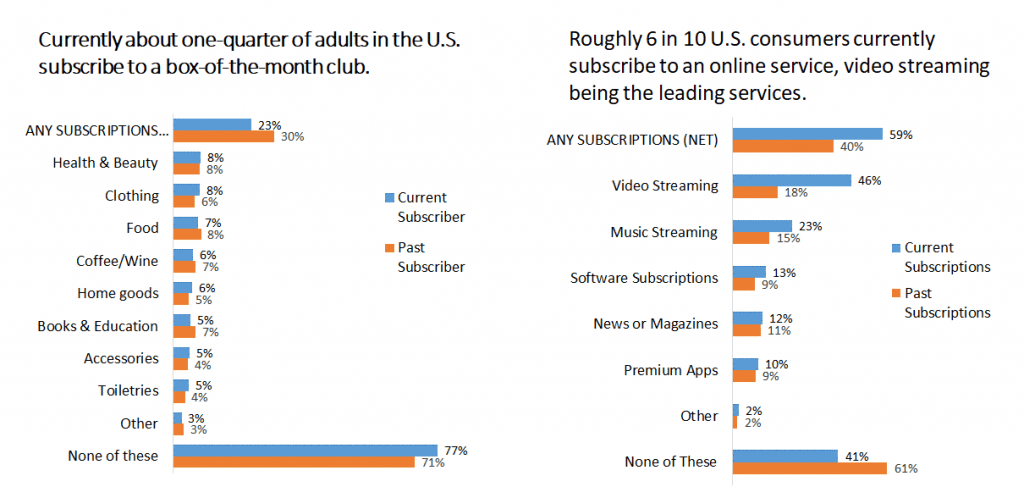
As the chart reveals, 23% of consumers have a box-of-the-month subscription, which includes things like meal kits, home goods, clothing, and health and beauty supplies. Close to 60% have a subscription to some type of media streaming service or software. “On the payment side of subscription payments, it can be a little bit involved for the merchant,” said Grotta. “It’s not just about payment processing, but also disclosures for recurring transactions and communications.”
Smith added that recurring ACH payments can benefit subscription companies the same way they do nonprofit organizations. “I’m amazed at the growth and the variety of products that one can get on a monthly subscription basis. We are all used to paying for streaming services, but you can also receive food, wine, beer and more,” Smith said.
“Some of these subscription companies are small businesses, and they want to focus on growing subscriptions and not the back office. By allowing consumers to use ACH for these recurring monthly payments, the subscription industry can see a lot of the same benefits as the nonprofit industry, including more of the payment going to the bottom line,” Smith said.
The organization ProfitWell, a provider of subscription analytics, found that in the subscription industry, 20% to 40% of overall churn is due to delinquency. Much of this delinquency is caused by expired credit cards, and companies recover less than one-third of delinquent customers.
With ACH payments, these delinquencies could be prevented from happening at all. While credit cards work well for acquiring new subscribers, Smith said that converting them to recurring ACH after acquisition is a great way to retain them long term.
Conclusion
ACH is a valuable payment method that can be used across all industries, including nonprofit organizations, healthcare organizations, and subscription services. These industries can benefit greatly when their customers are able to pay or donate using ACH.